
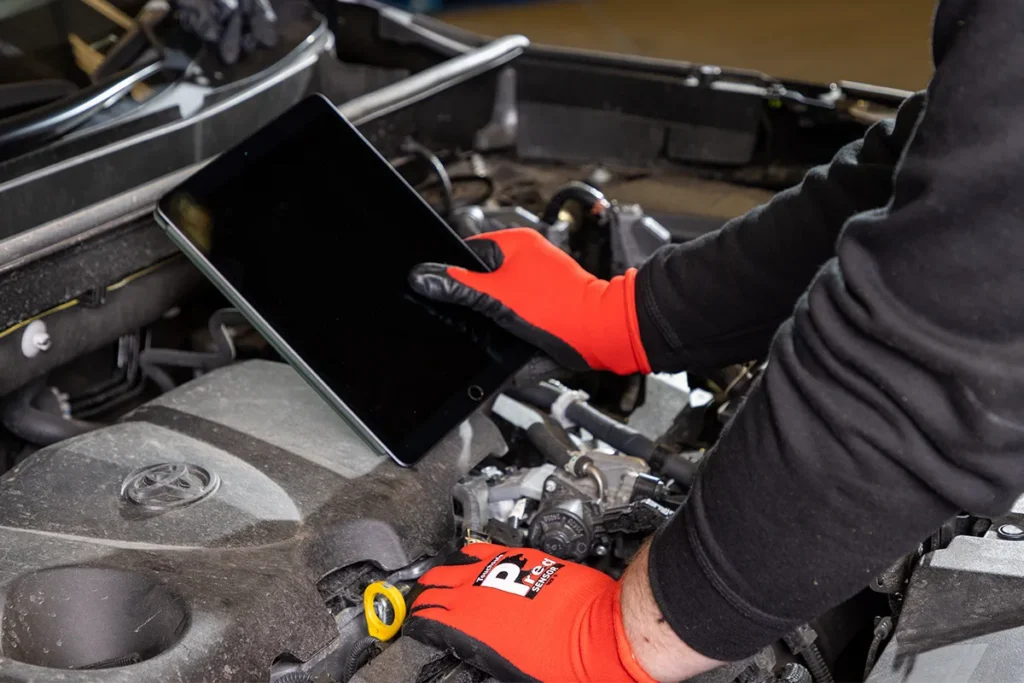
Automotive and mechanic work puts gloves through conditions most PPE isn’t built for: oil, grease, hydraulic fluid, sharp engine parts, and diagnostic equipment that needs a bare-finger touch to operate. A glove that’s too thick kills the feel you need for precision parts. One that’s too thin tears on the first jagged edge. Here’s what actually works, and why.
What to look for in automotive work gloves
Grip in oily and wet conditions. Standard smooth-palm gloves lose all traction the moment oil or coolant gets involved. A textured diamond grip pattern — moulded into the coating itself rather than printed on — keeps hold of tools and parts even when hands are slick.
Glove thickness (mil rating). Most disposable mechanic gloves run 4–5 mil. A 7.0 mil nitrile glove gives noticeably better puncture and tear resistance against sharp metal edges and bolts, without sacrificing the dexterity needed for fiddly assembly work.
Cut resistance (EN 388). Look at the EN 388 rating on the spec sheet, not just the marketing copy. A Cut 1 rating is fine for general handling; anything involving sharp sheet metal or fabrication work benefits from Cut D or Cut F.
Touchscreen compatibility. Modern diagnostic tools and tablets are part of the job. Gloves that aren’t touchscreen-rated mean stopping to remove a glove every time you need to check a reading — a genuine workflow cost across a shift.
Chemical and latex-free construction. Nitrile is the standard choice over latex for automotive work: better resistance to oils and solvents, and no latex allergy risk for staff or customers.
Best picks
Best overall grip — Ideall® Grip Green A 7.0 mil nitrile glove with a diamond texture on both the inner and outer surface, so grip doesn’t fail even when the glove itself gets oily inside. Rated for automotive, chemical, and assembly work. View product
Best for oily engine parts — Ideall® Grip Orange Built on the same Ideall® Grip platform, optimised for high-visibility handling in oily and wet conditions. If hands are in engine bays more than they’re out, this is the pick. View product
Best budget option — Ideall® Grip Black The same 7.0 mil diamond-texture construction at a lower price point for high-volume, everyday workshop use. View product
Best touchscreen-compatible glove — Pred Sensor A Polymax-coated, Cut 1-rated glove designed for automotive, assembly, and engineering environments where diagnostic tablets and touchscreens are used throughout the shift. View product
Best for heavy-duty puncture protection — Pred Impact Cut F rated with a Polymax coating, built for automotive and metalwork environments involving sharp edges and higher impact risk. View product
Best value disposable — Nitrylex Strong A 100% latex-free, powder-free nitrile disposable suited to automotive, chemical, and assembly tasks where gloves are changed frequently across a shift. View product
Best for arm and forearm protection — Pred Cobra Sleeve Cut F-rated sleeves for automotive and engineering work where forearms are exposed to the same hazards as hands — useful alongside any of the gloves above rather than as a standalone pick. View product
Nitrile vs. other materials for automotive work
Nitrile is the default recommendation for automotive and mechanic work: strong resistance to oils, greases, and most workshop chemicals, without the allergy risk that comes with latex. Latex gives comparable grip but degrades faster on contact with petroleum-based products, which makes it a weaker fit for engine bay work specifically. PVC and PU coatings are more common in general handling and construction, where raw durability matters more than fine tactile control.
FAQs
The Ideall® Grip Orange, Green, and Black ranges are built for this — a high-traction diamond texture designed specifically for oily and wet environments, at 7.0 mil thickness for added puncture resistance.
Yes. Gloves like the Pred Sensor and the Nitrylex range are touchscreen-compatible, so technicians don’t need to remove gloves to use tablets or diagnostic equipment.
A 7.0 mil glove is significantly less likely to tear or puncture when handling heavy tools or jagged metal edges than a standard 4–5 mil disposable, without a major loss in dexterity.
Most of the automotive range is 100% latex-free and powder-free, reducing the risk of skin irritation and Type I allergic reactions.
Find the right glove for your workshop
Explore the full automotive & mechanic glove range, or use our glove selector guide to match a spec to your team’s exact conditions. Free samples are available for trade buyers — request yours here.