Welding Gloves
MIG welding gloves
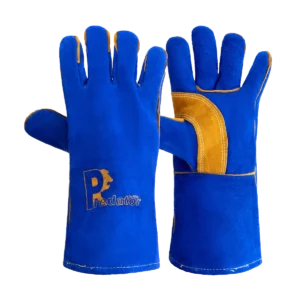
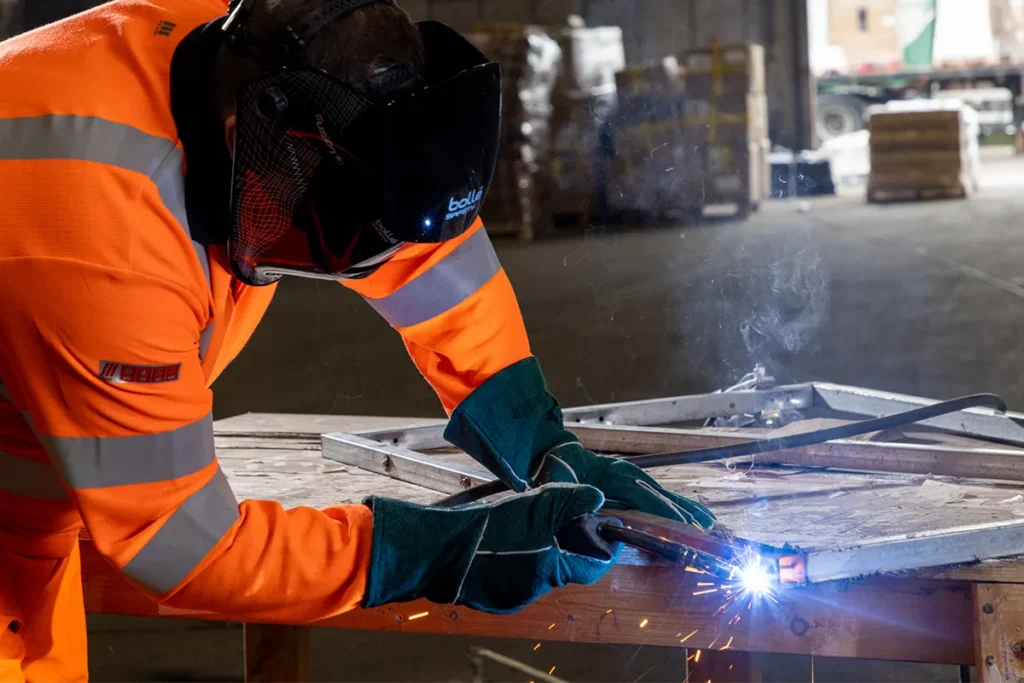
MIG welding throws a lot of spatter, so the glove needs solid coverage across the back of the hand and a cuff long enough to protect the wrist. Dexterity matters less here than in TIG work: most MIG welders are gripping a gun, not threading a needle, so a slightly thicker leather that holds up to spatter and abrasion is the right trade-off.
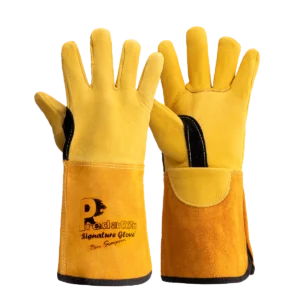
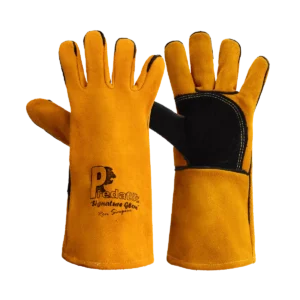
Our Signature MIG Gauntlet and Signature MIG Glove are built for exactly this. Reinforced palms take the wear points MIG welders hit hardest, and the extended cuff keeps sparks off the forearm during overhead or awkward-angle work.

TIG welding gloves
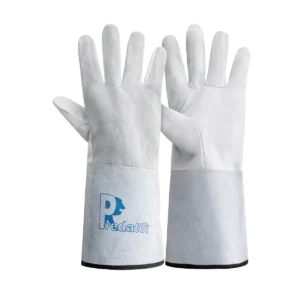
TIG is a different problem entirely. Welders need to feel the torch and the workpiece, so the glove has to be thin, close-fitting and pliable, while still keeping heat off the skin. Too much padding and control suffers; too little and welders end up removing the glove between passes, which defeats the purpose.
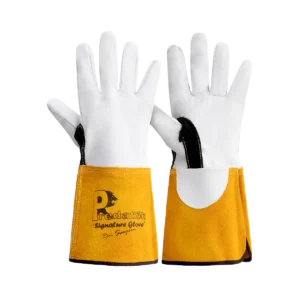
The Signature TIG Gauntlet uses a thinner leather construction specifically for this. It’s built to stay on the hand through a full shift rather than get pulled off every few minutes.
Leather welding gauntlets for general use
Not every job fits neatly into “MIG” or “TIG.” Stick welding, multi-process work and general workshop use often call for a heavier gauntlet that isn’t optimised for one process specifically.
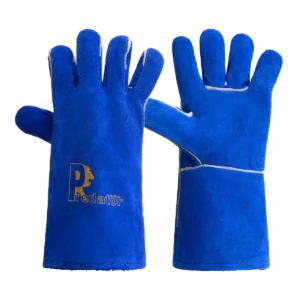
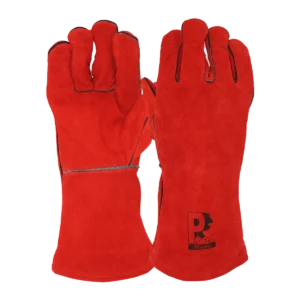
Split-leather gauntlets are the more affordable, more heat-resistant option, and they’re a sensible default for general fabrication or maintenance work where budget and durability matter more than fine dexterity. Full-grain leather costs more but tends to last longer and mould better to the hand over time. If your team is doing a mix of arc welding, grinding and general handling in the same shift, our Pred-Cotton-Chrome range covers that middle ground well.

How to choose: welding glove standards explained
If you’re signing off PPE for a team, the spec sheet matters as much as the price. Two standards come up most often:
EN 12477 covers protective gloves for welders, and splits into Type A and Type B. Type A gloves offer higher protection levels but are generally bulkier and less flexible, suiting MIG and general welding. Type B gloves trade some protection for improved dexterity, which is why most TIG gloves are certified to Type B rather than Type A.
EN 407 rates heat performance across several categories, including contact heat, convective heat and resistance to small splashes of molten metal. A higher rating doesn’t automatically mean “better” for your team; it means better suited to higher-heat, higher-risk work. A groundworker doing occasional stick welding doesn’t need the same rating as someone running MIG all day in a fabrication shop.
Cuff length and lining are worth checking too. Longer cuffs protect more of the forearm but can restrict movement in tight spaces; a cotton or fleece lining adds comfort in cold workshops but isn’t necessary for warmer environments.
For a broader look at how these standards apply across our whole glove range, see our guide on how to choose safety gloves.
Buying for a team or in bulk?
Kitting out a whole team is a different exercise to buying one pair. You need consistent sizing, a supplier who can hold stock for repeat orders, and pricing that reflects volume rather than one-off retail rates. We work with procurement teams and H&S managers on exactly that, and we can flex minimum order quantities for teams that are still figuring out which glove suits their process.
If you’re not sure which glove is right for your welders, get in touch and we’ll help you match spec to job before you commit to a bulk order.
Not sure which glove suits your process? Contact us and we’ll help you work it out.
Our Welding Gloves
Our most popular choices for professionals.